SOUP: Anything for Love

By Jen Harris

SOUP offers a content warning prior to every column, as the subjects discussed herein may be triggering for some readers. Please proceed with caution. If you would like to try a grounding technique for triggered moments, here is a personal recommendation.

The song goes, “I would do anything for love… but I won’t do that,” and the great debate is, “What IS ‘that’?”

That is all of the things that wreck a relationship: addiction, codependency, attachment style, jealousy, infidelity, financial strain, untreated mental illness, misogyny, sexism, racism, sexual repression… the list is long. So, the song is inherently claiming, “I would do anything for love, except be human.”

Historically I’ve claimed to be the sort of person who “won’t do that,” even though I totally DO THAT and that and that. I’d still like to believe I would do anything well-intentioned and healthy for love.

Continue reading
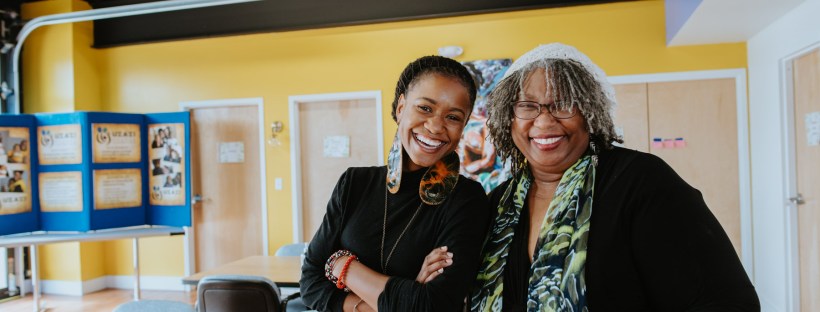
Uzazi Village is nurturing Black mothers and birthing bodies, and fighting health inequities in Kansas City

By Kelcie McKenney

Sandra Thornhill came to Uzazi Village in 2018 when she was pregnant with her son Jerren Junior. 

“That’s where I met the co-founder and CEO of Uzazi Village, Mama Hakima,” Thornhill said of Uzazi Executive Director Hakmia Tafunzi Payne. She had stopped by for a labor and delivery class and got to talking to Payne about where she wanted to give birth. At the time, Thornhill wanted to have a home birth, but felt like going to the hospital was easier. 

“But [Payne], being the true, authentic, warrior sister that she is, called me out,” Thornhill recalled. It turned into an hour long conversation about the autonomy of Thornhill’s body and that she had every right to determine how she wanted her birth to take place.

“Two years later, that has taken me on a journey to always question, ‘Am I being the most true and authentic?’” Thornhills said. “So after having my son, who is a boy, I realized that my first child would be a Black male. And looking at the climate of the existence and history of Black men in America—not only in America, because I’ve traveled internationally—and seeing how the Black male was treated, that made me realize I don’t want him to have to wait until he’s 27 or 28 to realize that your voice matters.”

Continue reading

SOUP: The Fragility of Growth

By Jen Harris

CW: C-PTSD, trauma

What happens when you “walk through something” in life? When people speak of being glad to be “on the other side” of that time of sorrow, grief, suffering; what do they mean?

I have always wondered what they mean, especially when I witness firsthand (and am totally freaked out by) their inner glow. A healed person, a person who has done the work possesses an uncontainable, undeniable, light. A light they seemingly acquired on this journey they’re illustrating but…wait. What?

What do you mean, the only way out is through?

Yeats said, “If suffering brings wisdom, I would wish to be less wise.”

Continue reading

Promising Young Woman is a Revenge Movie, But It’s Also a Tragedy

By Abby Olcese
Originally published on thepitchkc.com

Forgiveness is a tricky thing. In the church, I was taught that we’re supposed to forgive the people who do us wrong. Simple enough in Sunday school—you take my cookie, I might get mad, but it’s not a huge deal.

I can forgive you. I’m still a Christian, and I still believe in forgiveness.

As I’ve gotten older, however, I’ve come to understand that it looks different when the transgression is more complicated than taking my Oreo during snack time. 

In Christianity, asking God for forgiveness comes with the understanding that you’re not going to blindly commit the same sin again. When we forgive others, the same sense of grace is present. We forgive not to diminish the fact we were hurt—wrong is still wrong—but because we’re hoping the person we forgive understands the consequences of their actions, and is sorry. It’s a healing process that’s meant to go both ways.

Emerald Fennell’s Promising Young Woman is an exploration of what can happen to a victimized person when there is no atonement.

Continue reading

SOUP: Let’s Not Have the Same Holiday, Again.

By Jen Harris

Let’s Not have the same holiday, again.

I look up from the 2020 survival trek and oh, it’s that time again. No, not my period. Christmas. I’m talking about Christmas. I’m surprised to smell apple cider and hear holiday music. Are we really celebrating this year, after everything that’s happened? It feels remarkably disrespectful to healthcare and essential workers, the dead, the dying, and those isolated in the purgatory of uncertainty to be glutenous after such a disparaging year, but it appears there are those who are going forward with holiday plans under the guise of being grateful for what remains.

It’s the holiday season (holiday season) // Whoop-dee-doo (Whoop-dee-doo)

Or at least, I think those are the words. Nonetheless, that’s my overall vibe about this year’s holidays. I struggle with holidays. It’s been my experience that many of us struggle with holidays, especially within the queer community.

Look, I’m not trying to exclude anyone, I’m just saying, when it comes to queers and holidays, any holiday, MOST holidays: it’s loaded. Proceed with caution.  

Continue reading