
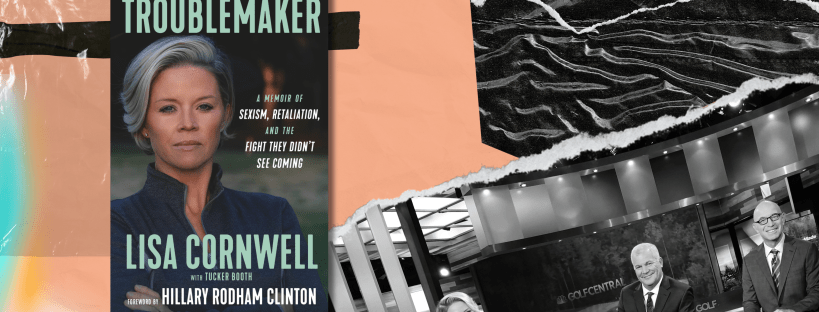
By Sophia-Joelle McDowell
Collage by Kelcie McKenney
Lisa Cornwell is a four-time Arkansas Women’s State Golf champion, a two-time AJGA first-team All-American, and a two-time All-State basketball player. In 1992 she was named the Arkansas Female Athlete of the Year and has been inducted into the Arkansas Golf and Arkansas Sports Hall of Fame.
After her strong athletic career, Cornwell found herself on the path of journalism. Before Cornwell was an on-air host for Golf Channel, she worked for the Big Ten Networks and local affiliates in Mississippi, Tennessee, and Ohio. Over the years, she earned a reputation for delivering excellent interviews and was genuinely great at her job.
As described in her book, Troublemaker: a Memoir of Sexism, Retaliation, and the Fight They Didn’t See Coming, Cornwell has never had a problem standing up to bullies.
The perfect story to depict this spirit is when she witnessed a man hit a woman during her freshman year of college. Instead of blending in with the crowd on the sidelines doing nothing, she grabbed a 3-iron from her golf bag and took a stand. This is the same energy she brought when publicly speaking out against the misogynistic culture at Golf Channel/NBC Universal.
She refused to stay quiet during her years working for the network, and like many other women, it earned her the label of a “troublemaker.” Her fight led to a public smear campaign and her dismissal. Now she’s shedding light on the toxic environment she worked in and the ways it was covered up.
We spoke with Lisa Cornwell about her memoir and the lasting impact she hopes it has on women and the world in which we work.

Why did you feel you needed to share your story?
I felt that I needed to share my story for a lot of factors. I mean, the more that I went through this process, and the more that I talked to other women who had been through very similar situations, some of which I knew about prior, some I didn’t, but I’ve realized that there’s this real fear in women to speak out, and I understand it. I think it’s part of the problem that happens, you know, these things get swept under the rug, they’re not talked about, they’re not exposed, and so it allows these issues to continue, because really, there are no repercussions. I mean, I saw it firsthand from management, I worked with at Golf Channel to the handling of HR with my case with other cases inside the walls of Golf Channel, and then when the Washington Post did this deep investigative dive on Golf Channel and a long time systemic culture that had been in place, you know, you start to think about, well, why did these things continue? I think that for me, the very simple answer was these things continue for a couple of reasons. Number one, management allows it and number two, there are no repercussions for those who misbehave badly. I wanted to put that out there publicly to expose what had happened. I wanted to name names, who had allowed these things to happen and been a part of my story, in the hopes of shining a bright light on what’s happened and try to do something about it.
Why did you choose this method to get your story out there?
You’re very limited unfortunately. I mean, you know, 60 Minutes wasn’t calling me to do a documentary on it, and my story is so long and detailed, and a lot of different things happened that led me to where I ended up filing two charges with the EEOC, the Equal Employment Opportunity Commission. So long form really was the only option. I tried to tell part of my story on social media and you can’t even come close to it, even in a long story like the Washington Post. I’ve been on several podcasts and none of those really do the story justice. Without being in a 256-page book, it’s just impossible to do it.

Have you faced any challenges or pushback from the network or anyone else since telling your story?
I would say 95% of it has been very favorable. I have women calling me and reaching out and messaging me all the time and even thanking me for speaking out. They can see that the culture is slowly but surely changing. There are people who, just for whatever reason, are completely uncomfortable with me speaking about this stuff, and they want to blame me instead of blaming the problem, but it’s been a very small percentage of people, and I’m thankful for that. If I was dealing with something that was more 50/50, it would be hard to tolerate consistently getting that pushback. I’ve received so many positive responses and messages, and every time I get a message from someone, whether I know about the story or not, it just sort of serves as a reminder of why this is important and why it matters and sort of motivates me to keep on going.

Women are often afraid to speak out and speak up for themselves. Do you feel that sharing your own story has helped others find their voice?
I think so. I hope it has. I think that a lot of women who’ve wanted to say more and speak out more, have still been reluctant to do so. I never criticize anybody for that. I tell people all the time that I’m walking, breathing, living proof that retaliation does exist. I think that it’s what limits whistleblowers and people sort of speaking this truth to power because they don’t want to lose their jobs. They don’t want to get blackballed in the industry that they’ve worked hard to rise up the ranks.
I think that you have to make a calculated decision, whether you can continue on in the environment that you’re working in, or that you’re in and tolerate sort of what’s happening, or are you like me, and you can’t sleep at night, knowing that you just let this stuff go. I’ve always been that person. I’ve never been able to let things like this go whether they’ve happened to me or they’ve happened to someone I know. I’m always the person who’s willing to step into the ring and not think about the aftermath of it.
That’s part of why I think the subtitle was called, A Memoir of Sexism, Retaliation, and the Fight They Didn’t See Coming. We specifically use that line because I don’t think a lot of places see this coming. You hear these stories of sexual harassment, but you don’t hear a lot of outspoken stories, or issues or pushback, really on stories of just everyday discrimination and retaliation when it comes to women. Oftentimes, because people don’t have a voice to use, and I wanted to be able to use my platform to bring it to life.
I think that maybe they didn’t see it coming, because a lot of people just stop going after it. When there’s really no end game. For me there wasn’t an end game, really, except for exposure. A lot of people back down to that because they know that retaliation does happen, the fear of losing their job and not being hired in another position similar to what they’ve had moving forward. I just didn’t care about it.
I think that that’s part of what blindsided them a little bit about this continued fight because I wasn’t worried about the pushback or what happened in the aftermath.
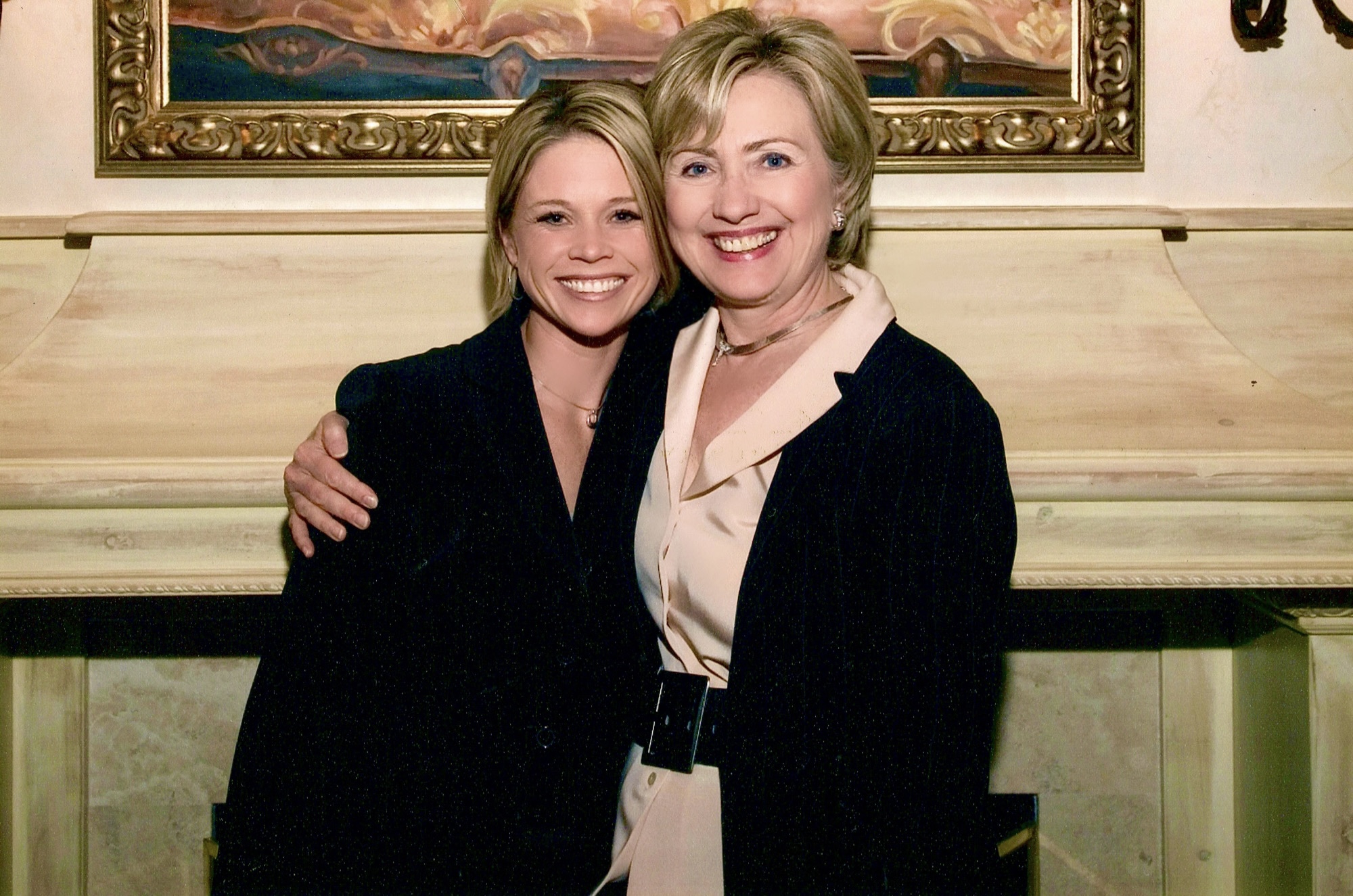
Hillary Clinton wrote the foreword for this book. How did it feel to read the foreword for the first time written by someone who has faced sexism and misogyny throughout her entire career?
It was pretty emotional to be quite honest. You’ve read it, and so you know that I’m related to Bill Clinton, and Bill and I are really close. Hillary has been one of those people who I’ve looked up to for most of my life. I’ve witnessed the sexism and discrimination that she’s faced firsthand and I know her in a way that a lot of folks don’t.
To see what she’s been through, and for her to continue to stay strong through it all, and then to put these words on paper, in defense of me and supporting me was one of the greatest honors of my life. Even though I know her personally, still the platform that she has and the credibility that she has in this area specifically means everything to me. People obviously in the political world that we live in will discount her in every single way that they can. I don’t know how any rationally thinking person cannot agree that she has faced a lot in terms of being a woman sticking up for equal rights and fighting for equality and fighting for her own self respect. You don’t have to get into politics to understand that.
But I will say I’ve had a lot of pushback from people with her writing the foreword. Now people say, you know, do you regret having Hillary write it because a lot of folks won’t read it? And my answer is always no. I mean, if you’re small-minded enough not to read my book, because Hillary Clinton wrote the forward, I don’t want you reading my book anyway. I didn’t write it for that, I didn’t write for a popularity contest, or to get other people’s approval. This was my own sort of cathartic journey, and having Hillary’s name on there, and her words supporting the mission and supporting that… and what she said is true. Sexism still exists, and she couldn’t have said it any better than that very last line.
“This is a thought-provoking, brave book, by a woman I liked as a little girl who grew up to be intelligent, honest, and strong. Reading it will make all of us more sensitive to discrimination still hiding in plain sight.”
What a perfect way to sum it up, and it is true. Sexism is out there, discrimination is out there, and people don’t even hide it. They try to pretend like it doesn’t exist. It’s right there in front of us, and our job is to pay attention to it and try to do something about it.
What is your hope for this book? What do you believe is its lasting impact?
I just hope that it keeps the conversation going. Like I said before, there is all sorts of news and media sensationalism surrounding sexual harassment, and rightly so, but I can promise you that discrimination and retaliation and just treatment in the workplace is a lot more prevalent than sexual harassment. They’re both horrible, but we can’t ignore one to highlight the other, because it’s a little sexier, for lack of a better word.
I mean, people want to talk about Matt Lauer and anything that involves sex because it just has that sort of global appeal for some reason, but we need to pay attention to this because it’s an everyday occurrence. For most women, I mean I can’t tell you the percentage, but if I had to guess 95% of the women who have heard about my story, who’ve read the book, who know what I’ve been through, they all say the same thing as that famous hashtag, #MeToo.
Me Too has always been associated with sexual harassment, but more women can say, me too in terms of this type of treatment. I’ve never been sexually harassed, but almost every woman I know has dealt with this in some way, shape or form in the workplace. I think that the mission is really just to shine a light on this behavior and to let folks know that it still exists, and it still exists more frequently than a lot of people realize. I just don’t want us to continue to ignore it and continue to sweep it under the rug because we have to do something about it. It’s too important.

Troublemaker
A Memoir of Sexism, Retaliation, and the Fight They Didn’t See Coming
Lisa Cornwell never shied away from standing up to bullies.
When she was a freshman in college, she saw a man hit a woman in the face with a closed fist while a paralyzed crowd stood by and watched. Seconds later, she took matters into her own hands—with a 3-iron from her golf bag.

Sophie McDowell (she/her) is a writer and creator currently living in Kansas City. She got her degree in mass media with an emphasis in film and video from Washburn University. She also has minors in art, history, and women’s studies. When Sophie isn’t writing or volunteering her time to social justice, she can be found hanging out with her pets.

Kelcie McKenney (she/her) is a writer, editor, and artist who is passionate about intersectional feminism, local activism, queer representation, and strengthening community. You can find Kelcie reading (probably smut or Twilight), talking astrology, hanging with her three-legged cat and four-legged dog, or trying to overthrow the patriarchy.

Disclosure: Some of the links included are affiliate links, meaning, at no extra cost to you, Catcall earns a commission if you make a purchase. Want to check out other books we recommend? Visit the Catcall Reads bookstore.
 Catcall